Losing a parent can force someone to grow up before they are ready. In those moments, it’s natural to rely on the people who remain without questioning them. But sometimes, trust can be quietly broken, only becoming clear years later.

It’s difficult for me to write this because I’m still trying to process everything. My stepdad came into my life when I was eight, so he was part of most of my memories. He was present in all the ways that mattered—school events, helping with homework, and everyday moments that made him feel like a permanent parent. When my mom died when I was 15, I didn’t see him as a stepdad anymore. He was simply the only parent I had left.
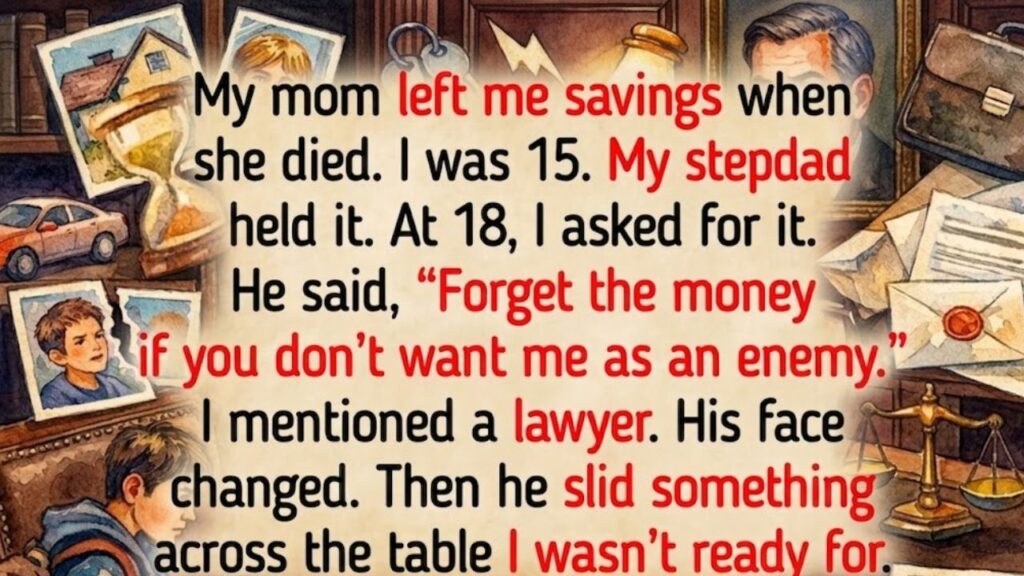
My mom had always saved money for my future.

Before she remarried, she had started a small savings account meant for my college or whatever path I chose after high school. My stepdad knew about this account, though he never added to it. It was always understood that the money was mine.

After my mom passed away, he took control of all her accounts and paperwork. I trusted him completely. When he said he would manage the savings for me, it felt like the obvious and safe choice.
For three years, I didn’t think much about the money. I was focused on finishing school and adjusting to life without my mom. But when I got accepted into college, I finally asked him about the savings.
That’s when everything changed.
He told me to forget about the money if I didn’t want him as an enemy. There was no hesitation or explanation—just a firm statement, as if the decision had already been made.
For the first time
I felt completely alone. I realized I had to stand up for myself. I told him I had a lawyer, even though that wasn’t fully true yet. I needed him to know I wasn’t backing down.
His reaction was immediate. He lost his confidence, sat down, opened a drawer, and handed me a folder.

Inside were bank statements, transaction histories, and a handwritten record of every withdrawal over the past three years. Each expense was labeled—food, bills, school costs, repairs. At the bottom was the total. Most of the money was gone.

What hurt the most wasn’t just the amount—it was how deliberate it all was. This wasn’t a mistake. It had been planned and justified in his mind long before I ever asked.
When I looked at him, I expected some kind of regret or apology. Instead, he calmly explained that raising me after my mom died had cost money. He said he had stepped in when he “didn’t have to,” and that the savings had been used to cover those years.
Then he said something that changed everything: “You’re not my son.”
At that moment, I knew I had to take action. The folder he gave me, which he thought justified his actions, became evidence. I took it to a lawyer, and the situation moved into a legal process where facts mattered more than explanations.

The case was slow but clear. The account had been designated for me, and he had only been managing it. The law viewed his actions as misuse, regardless of his reasoning. In the end, the court ruled in my favor and ordered him to repay the money over time.
But even with that outcome, it didn’t feel like a victory.
By then, the relationship was already broken—not because of the case, but because of what his actions revealed. We no longer speak. I’m in college now, and my tuition is covered, but it feels like I lost both my mom and my dad.